Project details
In Riihimäki, upper secondary and higher education in robotics is also developed through collaborative projects. The City of Riihimäki, Häme University of Applied Sciences and Hyria Education have joined together to create an authentic, actively developed care robotics learning environment. Other projects have involved the provision of joint robotics teaching and study material and the purchasing of robotics equipment. We actively cooperate to strengthen and improve the continuum of robotics teaching.
Find out more about our projects!
Robo CO. – Robots and AI as future colleagues 1 Sep 2023 to 31 March 2026 (ESF+)

The project is a joint project of the City of Riihimäki, Häme University of Applied Sciences and Hyria. The key objective of the project is to strengthen skills in work change.
According to research, the future of work transformation will contribute to a reduction in routine tasks and the acceleration of other tasks, and enable increased creativity and insight in work tasks supported by robotics and AI applications.
The transformation of work will affect every sector, and the application of robotics and AI will be a skill for every sector. This project aims to strengthen students’ work-based skills in robotics and AI by providing opportunities for collaboration with companies and by strengthening the possibilities for students to make connections with the world of work.
The project will develop the robotics and AI competences of teaching and guidance staff by designing and delivering in-service training. This will strengthen the pedagogical skills and application of robotics and AI in every profession.
The project will explore, investigate and pilot the potential of a virtual learning environment for the development of robotics and AI competences and explore national and international cooperation networks.
The project supports the implementation of the objectives of the Renewable and Competent Finland 2021-2027 programme’s specific objective 4.2, the Häme Union’s Smart Specialisation Strategy, the SMART Häme strategy, as well as the City of Riihimäki’s urban strategy and the strategic objectives of Häme University of Applied Sciences and Hyria.
The project is a joint project of the Robotiikkakampus actors. The project is funded by the European Social Fund (ESF+).
More information
-
The RoboCO. – Robots and AI as future colleagues project aimed to strengthen the competencies of students, teachers, and guidance personnel in a rapidly changing working life where robotics, artificial intelligence (AI), and digital technologies are becoming increasingly important across all sectors.
RoboCO has been at the forefront of preparing learners, educators and organisations for the ongoing transformation driven by robotics and artificial intelligence. The project sought to improve understanding of human–robot–AI collaboration, develop future workforce skills, and create new work-life-oriented learning environments and operating models through cooperation between the City of Riihimäki, Häme University of Applied Sciences (HAMK), and Hyria Education.
The project developed robotics and AI education, strengthened staff competencies, enhanced students’ work-life-oriented skills, and increased collaboration between educational institutions, higher education, companies, and other stakeholders. Activities included professional development programs, workshops, student projects, robotics and virtual technology learning environments, company collaboration, events, and both national and international networking.
The City of Riihimäki, acting as the lead partner, focused particularly on integrating robotics and AI into education, developing staff competencies, promoting hands-on learning for students, and strengthening the regional robotics ecosystem. Project activities were implemented as part of the Robotics Campus, which brings together education, working life, research, and development actors to support competence development and innovation.
Hyria’s contribution focused on developing robotics and AI learning environments and integrating them into practical teaching. Particular emphasis was placed on virtual and AI-enabled learning environments, student projects, and company collaboration that enabled authentic work-life-based learning experiences. Staff competencies were strengthened through professional development activities that directly influenced everyday teaching practices.
HAMK’s contribution focused on understanding learning challenges arising from technological transformation and providing technical support for robotics-related activities across the work packages. Through extensive collaboration with companies, HAMK gathered valuable insights into changing competence needs and how learning and skills development could better support organisations in times of rapid technological change.
The project demonstrated the value of a collaborative operating model. The complementary expertise of the City of Riihimäki, Hyria, and HAMK enabled broader actions, stronger networks, and more impactful results than would have been possible through separate organisational initiatives.
Work package 1 – Robots and AI as Co-workers: Staff Competence Development
Professional development activities strengthened teachers’ and guidance personnel’s competencies in robotics, AI, technological change, and future skills. Participants gained practical tools for integrating robotics and AI into teaching and guidance, while also deepening their understanding of ethical, pedagogical, and work-life-related implications of emerging technologies. As a result, technology-enhanced teaching practices became more widely adopted across participating organisations.
Work package 2 – Future Competencies: Student Skills Development
Students participated in workshops, projects, events, and discussions focusing on robotics, AI, automation, machine vision, and technological change. The activities strengthened both technical skills and broader future competencies such as problem-solving, collaboration, critical thinking, and adaptability. A key finding was that successful adoption of robotics and AI is fundamentally a question of learning, competence development, and change management.
Work package 3 – Virtual Learning Environments
The project developed and piloted virtual learning environments and VR/XR solutions supporting robotics education. Foundations were created for a future learning environment where students can safely test robotic systems and programming solutions in a digital twin environment before moving to physical robots. These developments support flexible, location-independent learning and will create new opportunities for technology education.
Work package 4 – Project Management, Communication and Networking
The project successfully coordinated communication, reporting, stakeholder engagement, and dissemination activities. Results were shared through websites, social media, events, conferences, and professional networks. Major public events included Riksun Robopäivät, SkidiRobo, Robots at the Railway Station, and VEX Robotics competitions, which increased awareness of robotics, AI, and future workforce skills among students, educators, companies, and the wider public. International networking activities included participation in events such as BETT UK, Automatica, and ICSR conferences.
The project successfully achieved its objectives. Competence in robotics and AI increased among both students and educational staff, robotics and AI became more strongly integrated into teaching practices, and learning environments were expanded through both physical and virtual solutions. Collaboration between education providers, higher education institutions, companies, and development organisations deepened significantly, strengthening the regional robotics and innovation ecosystem. The project contributed to a transition from isolated experiments toward a more systematic, work-life-oriented, and cross-sectoral approach to robotics and AI education.
The learning environments, educational materials, networks, operating models, and expertise developed during the project will continue to be utilised by the Robotics Campus, Hyria, and HAMK after the project’s completion, supporting the long-term development of robotics and AI competencies in the region.
Robotics Campus – Scale up! 1. Feb 2023 to 31. march 2024
The City of Riihimäki and Häme University of Applied Sciences (HAMK) are together developing a robotics competence and innovation center as a part of the Robotics Campus – Scale up! project. The city and HAMK invite growth companies in the region to develop a joint innovation ecosystem and utilize robotics and automation.
The project aims to enhance regional and international collaboration and promote robotics education, expertise, research, and innovation. The project consists of two components. The first component focuses on developing future skills. The project pilots further education in robotics for European school teachers in basic education. Furthermore, the project includes drafting an international project funding application for the development of robotics education.
The city of Riihimäki already includes robotics education in the curriculum from early childhood education to high school. Robotics studies can be continued in both vocational and higher education in Riihimäki. With the help of the project funding, HAMK strengthens its international offering of robotics education in the region.
The project receives support of 173,506 euros from the national funding allocated for regional development (AKKE) managed by the Häme Region.
Robo Care 1 Sep 2021 to 31 Aug 2023 (ERDF)
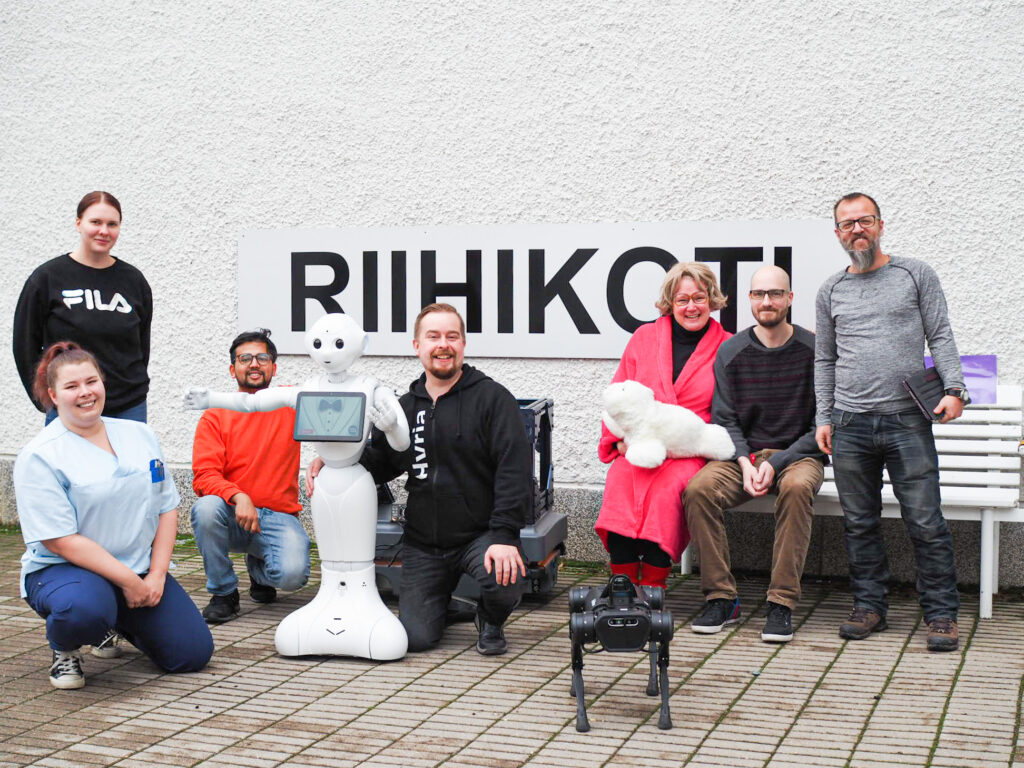
The Covid-19 pandemic introduced special requirements for health safety in care environments at a time when the shortage of nursing staff was turning into a major issue in Finland. Many stakeholders in society are increasingly looking to technology and robotics to solve these challenges. The project will test the use of four different robots as part of the daily life and care in a residential care home. The project will also build a prototype of a logistics robot. The project observes and studies the cooperation between robots and people, usability of robots and the perceived quality of care. Project activities are carried out by Riihikoti care home, care companies and services for older people.
The project’s objective is to identify possibilities that robotics can offer in care processes and everyday interactive care. The project will create a roadmap for care robotics, which will also provide a vision for the post-project development of the Robo Riihikoti learning and product development environment and Robohuone.
The project also includes the Robo Care investment project.
The main implementer of the project is the City of Riihimäki, and the co-implementers are Häme University of Applied Sciences and Hyria Education.
Riihimäki Robotics Learning 1 Aug 2019 to 31 Dec 2021 (ESF)
Robotics is becoming part of everyday life at an increasing pace. For that reason, it is important that robotics skills are developed with clear goals and a well-defined learning path through the educational system. Collaboration with upper secondary and higher education is vital. The Riihimäki Robotics Learning project created the Basics of Robotics course that can be completed by students at Häme University of Applied Sciences, Hyria Education and Riihimäen lukio general upper secondary school. The project has also designed and implemented sectoral robotics courses for vocational and higher education. The new robotics curriculum (25 credits) was launched at Riihimäen lukio general upper secondary school on 1 August 2021. These robotics studies can be accredited as degree studies at Häme University of Applied Sciences.
The Riihimäki Robotics Learning project also organised the Finnish Championships in Robotics held at Riihimäki Sports Hall in 2020 and remotely in 2021. Many other events have also been held, such as the Robotics Ethics lecture series, an afternoon event in the public library, several workshops and, together with the Robotics into Use project, the Riksun Robopäivät event.
The main implementer of the project is the City of Riihimäki, and the co-implementers are Häme University of Applied Sciences and Hyria Education.
Robotics into Use (Robo Riksu) 1 Aug 2018 to 30 Jun 2021 (ERDF)
Companies’ and service providers’ desire and need to put robotics into use are growing, while the development of multidisciplinary competences in robotics is only in its infancy. The Robotics into Use project implemented robotics product development and learning environments, and improved collaboration among companies. The project was guided through a start-up incubator path and participated in the activities of Riihimäki Business Park and Häme Design Factory. Networking and finding productive ways to collaborate were central to the project. However, as the Covid-19 pandemic closed educational institutions and companies at a critical time in March 2019, the metrics set for the project in terms of business cooperation were not met. Learning platforms acquired for the project included Pepper, Unitree A1, Paro and VEX learning environment equipment. Various experiments were conducted with robots in several environments, especially as the pandemic eased. An open event, Riksun Robopäivät, was held twice, once together with the Riihimäki Robotics Learning project.
The RDI environment set up by the project in Riihikoti residential care home for older people attracted major interest. In Riihikoti’s Robohuone room, residents, family members, nurses, students, researchers, product developers and equipment manufacturers could try out and test care robotics in a real care environment. A major success was the creation of the Robotics Campus consortium, where educational institutions and companies can collaborate and build up expertise in robotics in the region.
Robotics into Use collaborated with many other projects, such as Riihimäki Robotics Learning (ESF), Yhteistyörobotiikka – Robotiikan toinen sukupolvi (Collaborative Robotics – Second Generation of Robotics, ERDF) and Häme Design Factory (ERDF).
The main implementer of the project was the City of Riihimäki, and the co-implementers were Häme University of Applied Sciences and Hyria Education.